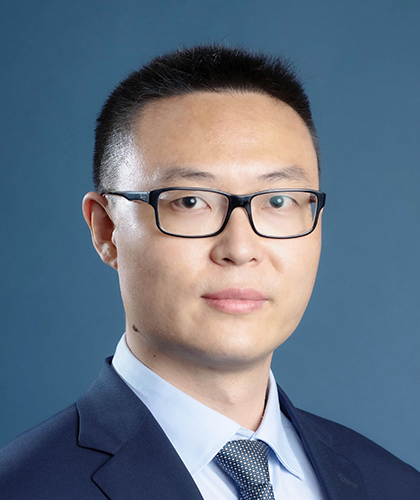
Cheng, Lin
Assistant Professor
Mechanical Engineering
Maryland Robotics Center
Maryland Robotics Center
2108 Glenn L. Martin Hall, College Park, MD 20742
Dr. Lin Cheng joined University of Maryland, College Park (UMCP) as an Assistant Professor in the Department of Mechanical Engineering in 2024. Prior to this appointment, Dr. Cheng was an assistant professor in the Department of Mechanical and Materials Engineering at Wocester Polytechnic Institute (WPI) for three years. Dr. Cheng received his PhD degree in mechanical engineering from University of Pittsburgh and worked as a postdoctoral researcher at Northwestern University from 2019 to 2021.
EDUCATION
- Ph.D., Mechanical Engineering, University of Pittsburgh, 2019
- M.S., Mechanical Engineering, Shanghai Jiao Tong University, 2014
- B.S., Mechanical Engineering, Xi'an Jiao Tong University, 2011
HONORS AND AWARDS
- NSF CAREER Award, 2026
- James Nichols Heald Award in Mechanical and Materials Engineering at WPI, 2023
- Fellow Competition Winner in virtual workshop, USACM, 2021
- Best Research Assistant Award in Mechanical Engineering, UPitt, 2018
- 1st Place in Poster Competition at RAPID + TCT conference, 2017
- Graduate Travel Award at International Solid Freeform Fabrication Symposium, 2016, 2017
PROFESSIONAL SERVICES
- Organizer/Chair of Conference: SES 2022, WCCM 2024
- Journal Reviewer (Selected): Nature, Additive Manufacturing, Rapid Prototyping Journal, Computer-Aided Design, International Journal for Numerical Methods in Engineering, Journal of Manufcturing Science and Engineering, Journal of Heat and Mass Transfer, Computational Mechanics, Computer & Structures, ASME Journal of Mechanical Design, Structural and Multidisciplinary Optimization, Journal of Manufacturing Processes, Scientific Report, Additive Manufacturing Letters
- Scientific Artificial Intelligence
- Additive Manufacturing
- Data-driven Modeling and Design
- Generative AI for smart structure and materials design
- Multsicale and Multiphysics Modeling
- Computational Mechanics
- Multifunctional/Robotic Materials Development
- In-situ Manufacturing Process Monitoring
- Materials in Extreme Environment
- L.C. Fang, L. Cheng, J. Glerum, J. Bennett, D. Dunand, J. Cao, G. Wagner, “Data-driven analysis of thermal analysis, microstructure and mechanical properties of IN718 thin wall deposited by additive manufacturing,” npj Computational Materials 8.1 (2022): 126.
- L. Cheng, and G. J. Wagner, “A representative volume element network (RVE-net) for accelerating representative volume element analysis, microscale material identification, and defect characterization.” Computer Methods in Applied Mechanics and Engineering 390 (2022): 114507.
- L. Cheng, and G. J. Wagner. “An optimally coupled multi-time stepping method for transient heat conduction simulation for additive manufacturing.” Computer Methods in Applied Mechanics and Engineering 381 (2021): 113825.
- L. Zhang#, L. Cheng#, H. Li, J. Gao, C. Yu, R. Domel, Y. Yang, S. Tang and W. K. Liu, “Hierarchical deep-learning neural networks: finite elements and beyond,” Computational Mechanics, 1-24, 2020. (# as Co-first author)
- S, Saha#, Z. T. Gan#, L. Cheng#, J. Y. Gao, O. L. Kafkab, X. Y. Xie, H. Y. Li, M. Tajdarb, H. A. Kim, and W. K. Liu, “Hierarchical Deep Learning Neural Network (HiDeNN): An Artificial Intelligence (AI) Framework for Computational Science and Engineering,” Computer Methods in Applied Mechanics and Engineering, vol. 373, 113452, 2021. (# as Co-first author)
- H. Deng, L. Cheng, X. Liang, and A. C. To, “Topology optimization for extreme damping design of architecture soft metamaterials,” Computer Methods in Applied Mechanics and Engineering, vol. 358, 112641, 2020.
- X. Liang, L. Cheng, T. Liu, and J. Du, “Nonlinear dynamic analysis of the bridge bearing and genetic algorithm–based optimization for seismic mitigation,” Advances in Structural Engineering, 23(12), 2539-2556, 2020.
- L. Cheng, and A. C. To, “Part-scale build orientation optimization for minimizing residual stress and support volume for metal additive manufacturing: theory and experimental validation,” Computer-Aided Design, vol. 113, 1-23, 2019.
- L. Cheng, X. Liang, J. Bai, Q. Chen, and A. C. To, “On utilizing topology optimization to design support structure to prevent residual stress induced build failure in laser powder bed metal additive manufacturing,” Additive Manufacturing, vol. 27, 290-304, 2019.
- H. Deng, L. Cheng, and A. C. To, “Distortion energy-based topology optimization design of hyperelastic materials,” Structural and Multidisciplinary Optimization, vol. 59, 1895-1913, 2019
- L. Cheng, J. Bai, and A. C. To, “Functionally graded lattice structure topology optimization for the design of additive manufactured components with stress constraints,” Computer Methods in Applied Mechanics and Engineering, vol. 344, 334-359, 2018.
- X. Liang, L. Cheng, Q. Chen, Q. Yang, and A. C. To, “A modified method for estimating inherent strains from detailed process simulation for fast residual distortion prediction of single-walled structures fabricated by directed energy deposition,” Additive Manufacturing, vol. 23, 471-486, 2018.
- L. Cheng, X. Liang, E. Belski, X. Wang, J. M. Sietins, S. Ludwick, and A. C. To, “Natural frequency optimization of variable-density additive manufactured lattice structure: Theory and experimental validation,” Journal of Manufacturing Science and Engineering, vol. 140, 105002, 2018.
- L. Cheng, J. Liu, and A. C. To, “Concurrent lattice infill with feature evolution optimization for additive manufactured heat conduction design,” Structural and Multidisciplinary Optimization, vol. 58, 511-535, 2018.
- J. K. Liu, A. T. Gaynor, S. Chen, Z. Kang, K. Suresh, A. Takezawa, L. Li, J. Kato, J. Tang, C. C. L. Wang, L. Cheng, X. Liang, and A. C. To, “Current and future trends in topology optimization for additive manufacturing,” Structural and Multidisciplinary Optimization, vol. 57, 2457-2483, 2018.
- M. Lynch, M. Mordasky, L. Cheng, and A. C. To, “Design, testing, and mechanical behavior of additively manufactured casing with optimized lattice structure,” Additive Manufacturing, vol. 22, 462-471, 2018.
- L. Cheng, J. Liu, X. Liang, and A. C. To, “Coupling lattice structure topology optimization with design-dependent feature evolution for additive manufactured heat conduction design,” Computer Methods in Applied Mechanics and Engineering, vol. 332, 408-439, 2018.
- J. Liu, L. Cheng, and A. C. To, “Arbitrary void feature control in level set topology optimization,” Computer Methods in Applied Mechanics and Engineering, vol. 324, 595-618, 2017.
- L. Cheng, P. Zhang, E. Biyikli, J. Bai, J. Robbins, and A. C. To, “Efficient design optimization of variable-density cellular structures for additive manufacturing: Theory and experimental validation,” Rapid Prototyping Journal, vol. 23, 660-677, 2017.
- X. Liang, W. Dong, S. Hinnebusch, Q. Chen, J. Lemon, L. Cheng, Z. Zhou, D. Hayduke, and A. C. To, “Inherent strain homogenization for fast residual deformation simulation of thin-walled lattice support structures built by laser powder bed fusion additive manufacturing,” Additive Manufacturing, vol. 32, 101091, 2020.
- X. Liang, Q. Chen, L. Cheng, D. Hayduke, and A. C. To, “Modified inherent strain method for fast prediction of residual deformation in direct metal laser sintered components,” Computational Mechanics, vol. 64, 1-15, 2019.
- Q. Chen, X. Liang, D. Hayduke, J. Liu, L. Cheng, J. Oskin, R. Whitmore, and A. C. To, “An inherent strain based multiscale modeling framework for simulating part-scale residual deformation for direct metal laser sintering,” Additive Manufacturing, vol. 23, 471-486, 2019.
- Y. Agarwal, K. Genc, T. Williams, P. Young, T. Pawlak, L. Cheng, S. Pilz, N. Brinkhoff, A. C. To, and P. W. Badding, “Inspection of computed tomography (CT) data and finite element (FE) simulation of additive manufactured (am) components,” Indian Society for Non-Destructive Testing (ISNT), 2019.
- Q. Yang, P. Zhang, L. Cheng, M. Zheng, M. Chyu, and A. C. To, “Finite element modeling and validation of thermomechanical behavior of Ti-6Al-4V in laser metal deposition additive manufacturing,” Additive Manufacturing, vol. 12B, 169-177, 2016.
- B. Yang, and L. Cheng, “Study of new global optimization algorithm based on the standard PSO,” Journal of Optimization Theory and Applications, vol. 3, 935-944, 2013.
- L. Cheng, and B. Yang, “Study of a new Global Optimization Algorithm of PSO based on improved very fast annealing simulation method,” Application Research of Computer, 2013.